
Forgive
When the command to forgive feels grossly unfair.

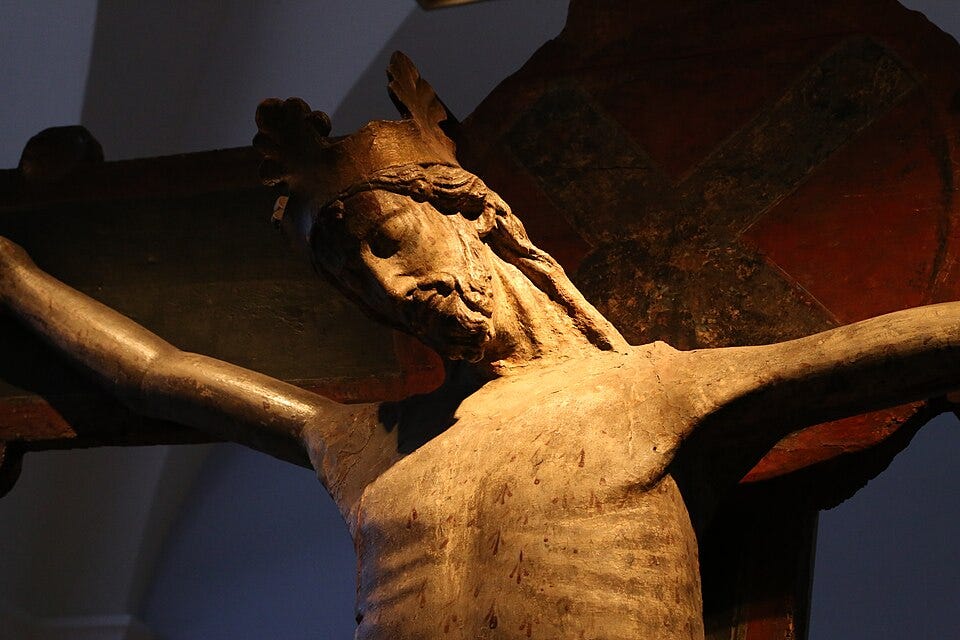

“Ew, NO.”
I was driving on the county roads near our house, returning from some errand or other. The kids were in the backseat, and I was rounding a bend in the midst of green millet and corn fields, the horizon shimmering in the June heat. I was still bleeding from the doctors cutting my dead baby out of me a week or two before.
The National Eucharistic Congress was bringing one of their nationwide Eucharistic processions through my hometown, and despite everything, I wanted to go. My husband wouldn’t be able to attend- he had work- and I’d still be recovering from surgery and have our three young children in tow for an hour long mass and a mile long walking procession to a neighboring parish by myself, through 90-something degree heat. Despite all that, I still desperately wanted to attend; it felt like a once-in-a-lifetime type thing to be a part of this. I was constantly weighing going in my mind, trying to decide if I could pull it off.
As I drove that day, I was doing just that, when I heard a still, small voice in my heart;
“You should go, and you should offer it up for Fr. N.”
Fr. N was the priest who had gained my trust, and then sexually assaulted me when I was in college1. I wasn’t the only woman he had done it to; by some miracle I was still in the Church, but the other two women I was aware of2 weren’t. This man had caused real, lasting harm. He'd recently passed away at a relatively young age from heart failure.
My response was both kneejerk and strong. There was no way in heck I was doing that. If I went, this was going to be a huge and difficult undertaking, I didn’t want to do something like that for him.
Then I realized Who I was probably talking to.
I took a deep breath and let it out slowly.
“Lord, I can’t stomach doing this and offering it up for...you know. I know that you love him though, and want him in heaven. I will go to this procession, and I will offer up any graces from it to you, to do with as you please. And if you use it for him, that’s up to you. They’re your graces now, I forfeit all right to them, you pick where they go.”
It was the best I could do.
In the “victim-survivor” community of those who have lived through sexual abuse by a member of the Catholic clergy, there’s a very strong emphasis on the idea that no one is owed your forgiveness. The concept of “forgive your enemies” has often been weaponized by unscrupulous Church administrators to coerce survivors who have come forward into silence- they’re told if they’re “good Catholics” or “real Christians” that they’ll forgive their abusers and the Church and let the abuser remain in ministry, or refrain from entering some sort of legal action against the diocese that mismanaged their allegation.
As a result, the ministries that I’ve been involved with that serve these people very carefully avoid insinuating that forgiveness of the abuser is something that should be expected or even necessarily pursued. “No one should ask that of you.” they say. “That’s something that’s up to you.” It’s not completely uncommon for someone to share that they’ve chosen not to forgive, that they’ll never forgive what happened to them.
I know from first hand experience where they’re coming from. Right after I came forward to the diocese where I was abused3 , the monastery where my abuser lived sent a lay representative to meet me. She went out of her way to make sure I knew that my testimony4 was what ultimately prompted the diocese to remove Fr. N from ministry and tried her hardest to get me to say I forgave him, “he can’t say public mass anymore and he’s worried that he won’t be able to say the funeral masses for his aged parents.”
I said I was working on forgiving him, but I refused to say that I thought he could go back into ministry, “that’s not my call, that’s his Abbot’s.” She returned to that point repeatedly during the rest of our conversation, and I finally said, “I can’t say I’m ok with him going back into ministry for the same reason I couldn’t trust a dog that had mauled someone around my kids. Maybe they won’t do it again, but they’ve shown they have the capacity for it, and I can’t trust them. I’m trying to forgive. But that doesn’t mean I can trust him anymore.”
She stopped asking after that.
The truth is that the language of forgiveness has been used as a handy cop out by those who don’t want to face important truths or do important work. Someone will share what happened to them with someone who has the authority to enact some change and be met with, “you really need to forgive.” Emotional manipulation towards a less disruptive course of action for the perpetrator (or those in relationship with the perpetrator) is not forgiveness, yet that seems to be the common name for it.
Even as much of the Church and society has this dysfunctional relationship with forgiveness as a concept, it’s an inconvenient truth that Christ says very clearly in the Gospels that we must forgive, “forgive us our trespasses as we forgive those who trespass against us.”(Matthew 6:12). While it is right and just to remove someone’s opportunity for further harming others, we have to forgive them for the harm that they’ve done. We cannot choose to hold enmity for that person in our hearts, and we cannot seek revenge against them.
Most difficult of all, we are called to actively seek out their good.
Probably the best explanation I’ve ever heard of this comes from Fr. Dan Rehil, a priest who survived being sexually assaulted by his pastor as a child;
[You look at Christ and you say] because you said to forgive, I’m choosing to forgive this person and I’m asking you to forgive them too so they can uh become the saint you made them to be and get home to heaven. Bless and heal them. Okay? This is what Jesus did on the cross. He uses the victim to heal the perp. And that’s just how it works.
It doesn’t sound fair because it’s not fair. Nothing about the cross was fair. He was the perfect person that never did anything wrong to anybody. And yet he’s the one who had to take all the sins to himself.5
Christ, in His love for both the person harmed and for the person who did the harming, calls us who have been harmed to help those who have harmed us towards their ultimate good.
It’s a hard thing to hear, and a gut wrenching thing to live out. But, distasteful as it feels, it’s what’s asked of us, and it’s how God brings about our healing.
A couple days after that drive, I got the kids dressed and loaded them into the van. We made it through the mass (though not without a full scale excursion to the outdoor bathroom halfway through), and joined the procession afterwards.
It was bedlam. The only orderly thing about it seemed to be the pickup truck and priest in front, and the city blocking out the route for us. In the front, near the canopy, a group were gamely trying to sing hymns. Just a few feet behind them, another group was leading a rosary and just a few feet from them, a handful of people were praying the Divine Mercy Chaplet. Others just walked and chatted with their neighbors. I had been able to find another mother I knew who was there with her children, and we both gave up on any kind of structured prayer and mostly focused on trying to keep the kids together in the crowd.
As it happened, the priest who had said the mass and was carrying the monstrance was someone else who I was struggling to forgive— a man who had sexually harrassed someone close to me, and who the diocese seems to be turning a blind eye to. As we walked along, I found myself people watching. The thought struck me that this wasn’t an inaccurate microcosm of the Church as a whole; a group of diverse people doing a variety of things, but all following the same Person. It was messy, but we were all more or less traveling the same direction.
I didn’t like the man who was holding the monstrance, but that also didn’t matter— I wasn’t following him, I was following Christ. And Jesus was there, and He was there regardless of the faults of the man carrying Him.
Just a noisy, chaotic crowd full of sinners, even horrible sinners, but with Christ at the front. It didn’t matter who else was there, He was.
We knelt for benediction in the receiving parish, which was full of the powerful silence that only seems to be present when the Eucharist is there. Then, as the Catholic school kids from the parish loaded onto a school bus and the priests and deacons found a place in the back of someone’s pre-arranged pickup truck trailer, the other mother and I realized we had to walk a mile back through town, without the police escort that had blocked traffic when we walked through the first time. We were hot, sweaty, and tired (and I was sore) by the time we got back, but we managed it. I took it easy for the rest of the day, and gave thanks to God for air conditioning.
I had done it, and I was keeping my promise. Those graces I gave back to Christ to use as He would, even if it was for Fr. N.
I don’t have a bow to tie on forgiving Fr. N. I don’t think about him much anymore, and I’ve started remembering happier memories from that time in my life. When I do think about him, it’s more neutral. When we had a conversation with my children about concussions (I have a 10 year old boy, such things come up naturally), I was able to remember and recount Fr.N’s concussion after a car accident without feeling angry or bitter at him for being someone that I used to know.
I’m still not sure I want to see him again someday in Heaven. I hope by the time I die, I will. I pray about that sometimes.
I don’t live in active anger or bitterness anymore. There’s days, even weeks, that go by now where I don’t think about what happened. I haven’t forgotten or think it doesn’t matter anymore, and I still do what little I can to help keep what happened to me from happening to someone else, but I do those things without living with an active sense of anger. What happened doesn’t rule my life, and I don’t feel that I live under a shadow.
Forgiveness is what has allowed that to happen.
These other two are those who I know by name. Mutual acquaintances of mine and Fr. N’s have told me that they’ve had many other women confide in them that they were assaulted as well.
Not my home diocese, which I recognize has made my life after the incident easier than what many victim-survivors face.
My testimony, which was at least the third public testimony to come out. There was a lawsuit, which had been covered in the local news, currently pending against the university that had had him on campus because two other women who he abused had reported him under a title IX violation and they had done nothing. If I remember correctly, the rationale for the diocese’s lack of action up to that point was that the other two women hadn’t bothered to fill out the official diocesan report sheet on their website.
Quotation source here. I highly recommend watching the whole video.
This is SO good. One of your best pieces. I was deeply moved by this. You, my friend, have a prophetic voice.
Emily, I am so touched by the truth and anguish that seep from your pen. Your description of the Eucharistic procession is right out of Flannery O’Connor’s short story «Redemption.» What a noisy, dysfunctional flock we are. I would love to ban (and maul) the wolves, but He didn’t ordain that. And the emancipation from anger you received, shows us that His way is the way of grace. Thank you. I’m going to pray that you get a restorative break from your wonderful, exhausting duties in the week ahead.